Four key components of ServiceNow Managed Services
If you’re out there looking for a ServiceNow MSP provider, the contract should cover the following key Managed Services areas:
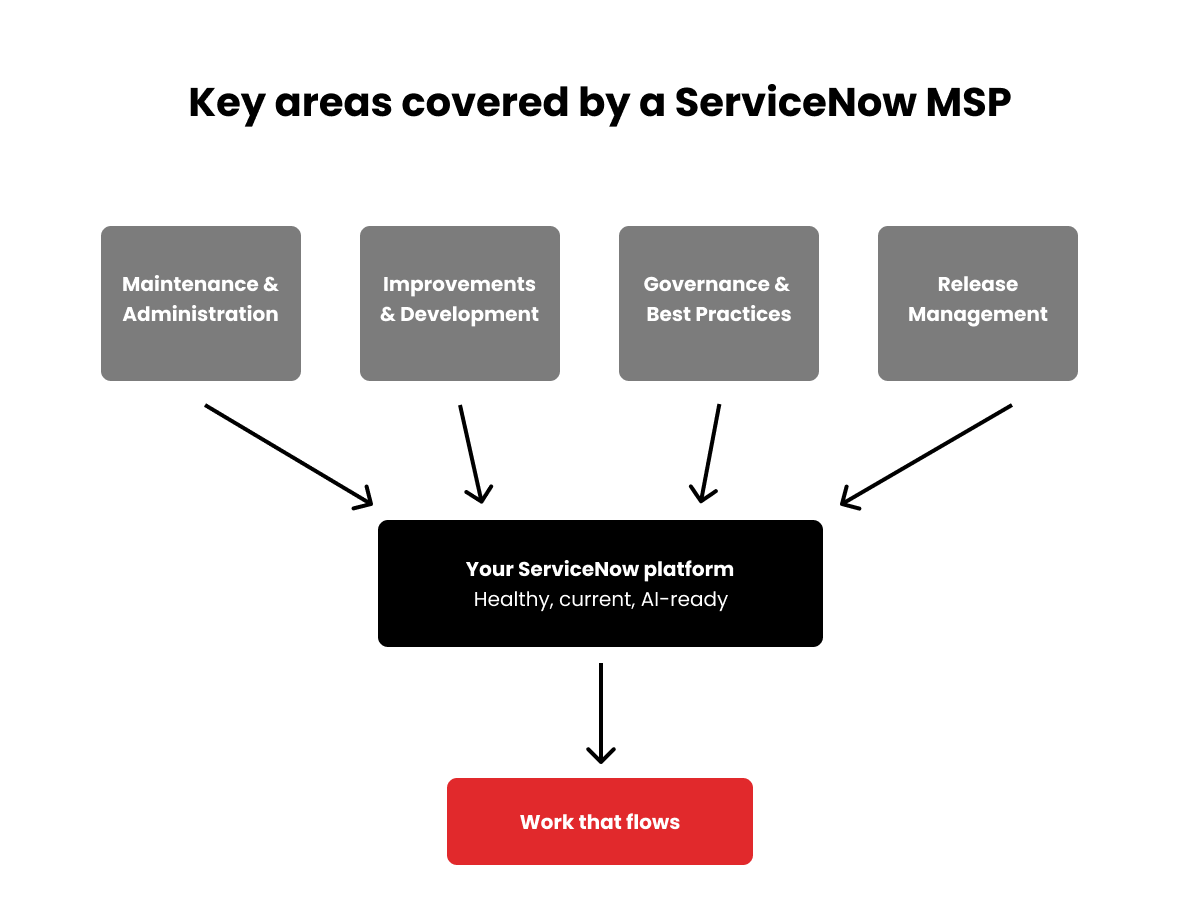
1. Platform Maintenance & Administration
This is the foundation: the unglamorous work that determines whether everything else succeeds. It includes:
- User administration
- Group and role management
- Instance monitoring
- Performance tuning
- Data quality and CMDB hygiene
- Incident resolution
- Service requests
- Small enhancements
Weak maintenance shows up later as slow forms, unreliable reports and AI features that produce garbage because the underlying data is bad. A well-maintained instance is also the entry ticket for everything ServiceNow ships next: agentic AI simply needs a clean CMDB to give it the results you want.
2. Continuous Improvement & Feature Development
After go-live, organizations typically only use a fraction of what their license includes. Continuous improvement means a standing capacity for enhancements: new catalog items, workflow automation, dashboards, integrations, AI use cases and the activation of features you already pay for but never switched on. The best-performing MSPs treat this as a product backlog with a product owner, ranked by business value and delivered in sprints, so the platform gets measurably better every sprint. Improvement stops being a project you fund once and becomes a rhythm.
3. Platform governance and best practices
Governance decides how expensive your platform becomes to own. Every undocumented customization, every script written against best practice, every quick fix in production adds technical debt that you pay back with interest at the next upgrade. That’s why a managed services partner enforces the following guardrails and best practices:
- Clear rules on who builds what
- Architectural review of new demands
- Obligatory use of OOTB functionality
- Coding standards
- Customization reviews
- Release readiness
- Instance scans
To save time and costs, an MSP can also use smart (proprietary) tooling to enforce guardrails by default, like Plat4mation’s Quality4U.
4. ServiceNow Release Management
ServiceNow releases two major upgrades per year, and instances must stay within the current release family. Every upgrade needs impact analysis, regression testing of customizations and integrations, and a controlled rollout. Organizations that handle this internally often skip releases to avoid the effort, then face a painful multi-version jump under time pressure. A managed services partner follows a set upgrading routine: they test in sub-production, execute on schedule, and use it as a moment to adopt the new capabilities each release brings. Staying current also matters more than it used to, because ServiceNow’s AI capabilities evolve release by release.
At Plat4mation, we’ve run managed services for 100+ organizations as a pure-play ServiceNow Elite Partner. This page explains all things ServiceNow Managed Services, why organizations choose it over in-house support or other models, and helps you decide whether it will pay off for you.
Managed Services vs. in-house support
In-house support gives you control and proximity. Managed Services gives you depth, continuity and predictable cost. Most organizations underestimate how much depth ServiceNow requires.
A single internal admin or a small platform team can handle tickets and basic configuration. The problems start when work needs to be done on the ServiceNow CMDB and CSDM design, integrations with ERP and HR systems, performance tuning, Now Assist and AI agent rollouts, and twice-yearly release upgrades. Each of those is a specialism. Hiring all of them means building a team of five or more, in a market where demand for ServiceNow skills is growing while the talent pool is lagging behind.
Pros and cons of in-house support vs. ServiceNow Managed Services
The table below will give you an idea of the pros and cons of in-house support compared to ServiceNow Managed Services:
|
In-house Support |
Managed Services |
| Expertise |
Limited to the people you can hire and retain |
Access to specialists across every module (ITSM, ITOM, CSM, HRSD, SecOps, GenAI), and industry workflow expertise |
| Continuity |
One resignation can stall the platform |
Team-based delivery, no single point of failure |
| Cost model |
Fixed salaries regardless of workload |
Flexible capacity that scales with actual demand |
| Upgrades |
Squeezed in between daily work |
Planned, tested and executed as standard practice |
| Innovation |
Rarely; the backlog eats all capacity |
Built into the model through dedicated improvement capacity |
| Best fit |
Stable, lightly customized single-module platforms |
Multi-module, integrated or AI-enabled platforms |
| Licenses & platform optimization |
License underutilization, non-compliancy issues related to usage |
Proactive advice on licensing to avoid shelfware, and compliancy issues to avoid penalties |
In practice, this rarely ends in a pure either/or decision. Many of our customers keep a small internal core (a Platform Owner, a Product Owner per workflow) and use Managed Services for everything that requires depth or flexibility. The internal team steers, the partner delivers.
What do ServiceNow Managed Services include?
A mature ServiceNow Managed Services contract covers the full operational lifecycle of the platform: keeping it running, keeping it clean, and moving it forward. Concretely, this includes:
- Platform operations – incident resolution, service requests, user and access management, monitoring and health checks
- Maintenance – patching, instance cleanups, performance tuning, data quality management
- Development – enhancements, new workflows, catalog items, integrations and custom applications
- Governance – architectural guidance, demand management, customization review, license optimization
- Release management – planning, testing and executing ServiceNow’s twice-yearly upgrades
- Strategic advisory – roadmap alignment, user adoption, change management and identifying AI use cases
- Continuous improvement – day-to-day improvements using AI and automation (like business process mining, Now Assist, and various AI tools and methodologies)
Scope varies by provider and contract tier. A basic contract might only cover maintenance and platform operations; a mature one takes ownership of platform value. The Plat4mation model runs in four tiers, ending in a tier where we actively drive the platform toward autonomous operations using AI, on a shared-risk, shared-gain basis. When you compare providers, ask exactly where their scope ends. The difference between “we resolve your tickets” and “we own your platform outcomes” is the difference between a helpdesk and a partner.
Why organizations use ServiceNow Managed Services
Four business drivers come up in nearly every managed services conversation we have.
1. Platform complexity has outgrown the internal team
ServiceNow started as an ITSM tool and now spans IT operations, HR, customer service, security, risk and AI agents. Each module a company adds multiplies integrations, data dependencies and governance questions. Analyst research from Everest Group shows customer and employee workflows now account for roughly 30% of ServiceNow’s net-new contract value, which means more organizations run multi-domain platforms where a mistake in one workflow ripples into others.
2. ServiceNow talent is scarce and expensive
Demand for ServiceNow transformation skills grew 55% globally in 2024 against 43% growth in supply (K2 Partnering Solutions). Senior architects and Now Assist specialists are the hardest profiles to find and the most likely to be poached. Managed services converts a recruitment problem into a contract clause.
3. The platform never stands still
Two major releases a year, monthly patches, and a fast-moving AI roadmap mean the work of staying current never ends. Internal teams sized for steady-state operations get overrun every time a release lands or a new capability like Now Assist needs rollout, adoption and tuning.
4. Cost optimization and predictability
A managed services contract replaces the fixed cost of a full internal team with flexible capacity. You pay for what the platform actually needs this quarter, scale up for an upgrade or a new module rollout, and scale down afterwards. Add license optimization and reduced technical debt, and total cost of ownership usually drops. Across the 40+ organizations where we’ve implemented Now Assist, AI-supported operations have reduced IT costs by up to 40%.
Scaling ServiceNow without growing internal teams
The most common growth pattern we see: an organization runs ITSM successfully, then wants ITOM, then HR Service Delivery, then Customer Service Management. Each expansion would traditionally trigger a hiring round for skills the market barely has. Under a managed services model, the same expansion is a scope change. Capacity, and the right specialists for each module, flex with the roadmap. Our contracts use a value credit model that works like a wallet: you agree on a monthly outcome, and you redirect unused development capacity to consulting, maintenance or anything else you need that month. The internal team stays small and strategic; the partner absorbs the variability.
Benefits of ServiceNow Managed Services
The biggest benefits of Managed Services lie in the business value and ROI it brings you:
- Faster time to value
New features, modules and AI capabilities go live in weeks instead of quarters, because the expertise and delivery rhythm already exist. Reusable assets matter here: our teams draw on a shared library of code, widgets and proven designs, which cuts delivery effort and shortens time to market.
- Better platform performance and adoption
Continuous monitoring, regular instance QA reviews and architectural guidance keep forms fast, integrations stable and data reliable. Users notice; adoption follows.
- Reduced operational costs
Flexible capacity beats fixed headcount, technical debt stops compounding, upgrades cost a fraction of a big-bang remediation, and license usage gets reviewed instead of quietly ballooning. AI-driven automation of routine platform work pushes costs down further year over year.
- Access to expert knowledge
One contract covers every specialism the platform demands: architecture, CSDM, integrations, performance, security and GenAI. You get the equivalent of a full expert bench, including profiles you could never justify hiring full-time, and you benefit from patterns proven across hundreds of other implementations.
- Proactive optimization
The most underrated benefit. Proactive optimization accelerates automations and detects unused licensed features and workflows that AI could handle end-to-end. That is where ServiceNow stops being an IT cost and becomes a business asset. It’s the reason our managed services customers score us a consistent 9+ on satisfaction: the platform keeps getting better without anyone having to ask.
About Plat4mation
Plat4mation is the largest pure-play ServiceNow Elite Partner based in EMEA, with 750+ specialists across 13 countries and a nine-time ServiceNow award winner, including the 2026 EMEA AI Customer Value Partner of the Year award. Want to know what Managed Services would look like for your platform? Book a call with one of our experts.